KE Load Shedding Schedule: How to Check Your Area’s Timings
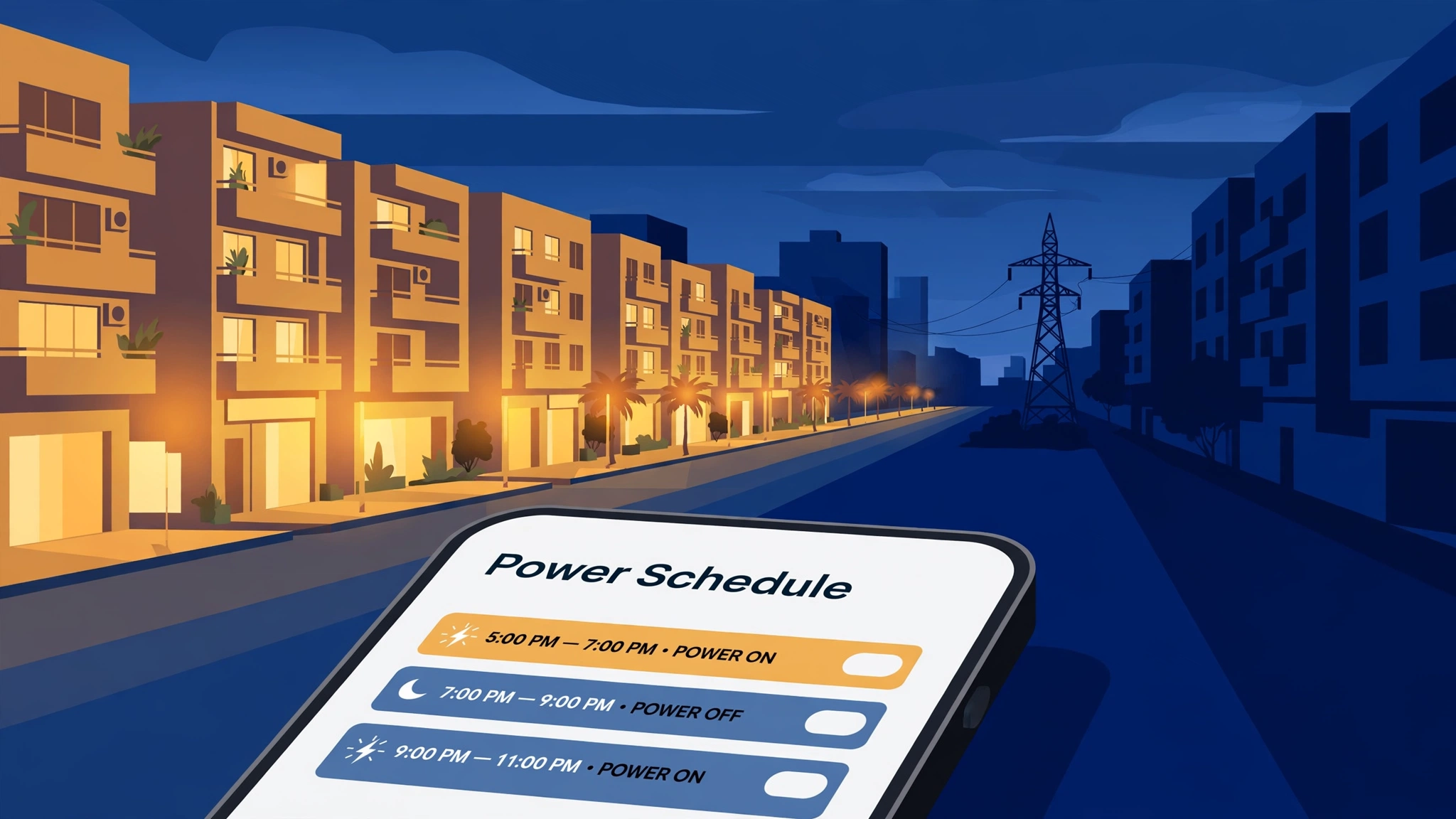
ke load shedding schedule is the first thing half of Karachi checks before planning the day — and for good reason. KE doesn’t cut every area equally. Your street’s outage hours depend on your feeder, and your feeder’s hours depend on its losses. So the house two streets over can sit in the dark for twelve hours while you lose power for six, and neither of you did anything wrong. This guide shows you how to find your exact timings in under two minutes, how to read KE’s schedule properly, and what to do when the lights go out off-schedule.
Quick answer: To check your KE load shedding schedule, send LS plus your 13-digit account number to 8119, enter the account number on KE’s Load-Shed Schedule page at ke.com.pk, open the Power tab in the KE Live app, or call helpline 118. Schedules are set feeder-wise, so timings differ from area to area.
Four Official Ways to Check Your KE Load Shedding Schedule
KE gives you four official routes to the same information. All of them need either your 13-digit account number or your feeder name — both are printed on your bill. If you can’t find your bill, here’s how to check and download your KE duplicate bill first.
| Method | What to do | What you need |
|---|---|---|
| SMS to 8119 | Send LS, a space, then your account number | 13-digit account number |
| KE website | Open the Load-Shed / Maintenance Schedule page and enter your account number | Account number from your bill |
| KE Live app | Tap the Power tab at the bottom | The app installed (Android/iOS) |
| Helpline 118 | Ask the agent for your feeder name and its timings | Your account number |
The fastest method on a basic phone
The SMS route is the quickest if you don’t have a smartphone handy — and honestly, it’s the one most Karachi households actually use. Send REG, a space, and your 13-digit account number to 8119 once to register your number. After that, sending just LS returns your schedule. Without registering, you add the account number every time. The same 8119 service takes complaints too: send COMP from a registered number. One honest caveat — reply times vary with network load, so if it’s urgent, the app or a call to 118 is more reliable.
The KE Live app is the better choice if you want more than just the timetable. Its Power tab shows your feeder’s schedule plus live outage information, and you can log a complaint and track it in the app instead of sitting on hold. The website route sits in the middle: enter your account number on KE’s Load-Shed / Maintenance Schedule page and you can also download the full schedule PDF.
Finding your feeder name
Your feeder is simply the power line that supplies your street — and it’s the key to everything else in this guide. KE prints the feeder name at the top of your bill. You’ll also find it on the Power tab of the KE Live app, or you can ask for it on 118. You’ll need the exact name, because KE’s schedule PDF is one long table organized by feeder, grouped under grid stations.
How to Read the Schedule: The Four Cycles Explained
KE publishes its schedule as a PDF where each row lists a feeder name, the grid station feeding it, and four time slots called cycles. A cycle is one load-shedding window. The current PDF is marked applicable from 5 August 2026, and KE notes that timings “may slightly vary.”
Reading a row looks like this: BLOCK # 5 RMU — AIRPORT — 1035~1335 | 1435~1735 | 1835~2105 | 2235~0205. That first cycle, 1035~1335, means 10:35 AM to 1:35 PM. Four cycles, four windows a day. To find yours: open the PDF (linked from KE’s schedule page), search for your feeder name, and read the four cycles across its row. Two practical tips — feeder names sometimes change, and several rows carry the old name in brackets, so search for both if you know the old one. And if your feeder isn’t in the PDF at all, check the separate “List of Feeders under the Loadshed Category” on the same page before assuming you’re exempt.
Why Your Area Gets More Load Shedding Than the Next Street
This is the part that confuses everyone, so here it is plainly: KE sets load shedding per feeder based on that feeder’s losses — electricity stolen plus bills never paid, which KE measures as ATC (aggregate technical and commercial) loss. Feeders with higher losses get more hours. Two streets a few hundred metres apart, fed by different feeders, can have completely different schedules.
KE’s own feeder-category list tells the story. Counted on 1 October 2026, it held 623 feeders: 133 Medium Loss, 163 High Loss, and 327 Very High Loss. In the schedule PDF, medium-loss feeders show roughly 6 hours of cuts a day; high and very-high-loss feeders show about 12. The honest verdict nobody at KE will say out loud: if you pay every bill on time but share a feeder with people who don’t, you get the same cuts. The feeder’s numbers decide, not your house. The only real way out is collective — when a feeder’s losses fall, KE can move it to a lower category at its next review.
Longer outage hours don’t change your per-unit electricity rate, but they do change how you plan consumption — and if you’re trying to make sense of a bill that feels too high, our KE tariff rates page with the bill calculator breaks down exactly how your units turn into rupees.
Load Shedding Is Not the Same as a Planned Maintenance Shutdown
This trips people up every month. Planned maintenance shutdowns — KE shutting feeders for inspections and repairs — are NOT part of the load-shedding schedule. KE’s schedule page has a separate account-number lookup for maintenance: it shows the feeder, date, time, and scope of any planned shutdown, or “No maintenance shutdown planned.” A feeder can be completely exempt from load shedding and still go dark for a few hours while crews work on it.
Make it a habit to check both before anything important — an exam, a work-from-home deadline, a family event. NEPRA’s service standards say power companies must give affected consumers at least 48 hours’ notice of planned outages, so keep your mobile number updated with KE; that’s how the notice reaches you.
What Changed in October 2026
Schedules aren’t frozen — they shift with generation shortfall and season, and October brought a real change. On 14 October 2026, KE withdrew the temporary additional load management it had imposed during an RLNG supply shortage, after fuel supplies resumed. That was extra load shedding on top of the regular timetable, and it’s now gone. The regular feeder-wise schedule — the one applicable from 5 August 2026 — continues as before. If your area still sees long cuts, check your feeder’s listed cycles first: what feels like “extra” load shedding is usually just the normal 12-hour timetable on a high-loss feeder.
When the Power Goes Out Off-Schedule
If your lights go out outside your listed cycles, or stay out longer than the cycle says, that’s a fault — a tripped feeder, a blown transformer, local damage — not load shedding. Report it. Call 118, message KE on WhatsApp at 0311-3333333, or use the SMS service at 0348-0000118. In the KE Live app you can log it and follow its progress. Write down every complaint number you get. If KE doesn’t resolve it, the next step is NEPRA’s online complaint system — file with your complaint numbers and outage times, within one year of the incident.
Planning Your Day Around the Four Cycles
Once you know your four cycles, the schedule stops being an annoyance and becomes a planning tool. Most households do three things:
- charge phones, power banks, and the UPS or inverter batteries in the windows between cycles, not during them;
- run heavy appliances (washing machine, water pump, iron) in the longest lit stretch of the day;
- keep one cycle’s timing memorized — usually the evening one — because that’s the outage everyone actually feels.
If you work from home, match your deep-work hours to your longest uninterrupted window and keep the 118 helpline saved in your phone for the days the schedule and reality disagree.
Frequently Asked Questions
How do I check my KE load shedding schedule by SMS?
Send LS, a space, and your 13-digit account number to 8119. Register once first with REG plus your account number, and afterward you can send LS on its own.
Where do I find my feeder name?
At the top of your KE bill, on the Power tab of the KE Live app, or by asking on helpline 118. You need the exact name to read KE’s schedule PDF.
Why does my area get more load shedding than a nearby area?
KE sets hours per feeder based on its losses from theft and unpaid bills. High-loss feeders get longer cuts — about 12 hours a day on paper — while medium-loss feeders get around 6.
How many hours of load shedding does KE schedule?
In the schedule applicable from 5 August 2026, medium-loss feeders show roughly 6 hours a day and most other listed feeders show about 12. Your feeder’s own row in KE’s PDF is the exact answer for your street.
Is load shedding the same as a planned maintenance shutdown?
No. Maintenance shutdowns are separate, announced repair windows with their own lookup on KE’s website. Check both before an important day — a feeder can be exempt from load shedding and still lose power for maintenance.
What should I do if the power goes out outside my schedule?
Treat it as a fault, not load shedding. Report it to KE on 118 or WhatsApp, keep your complaint number, and escalate to NEPRA’s online complaint system if it isn’t fixed.
kelectricbill.pk is an independent informational website and is not affiliated with K-Electric. For official schedules and announcements, always verify on KE’s own channels — see our disclaimer.